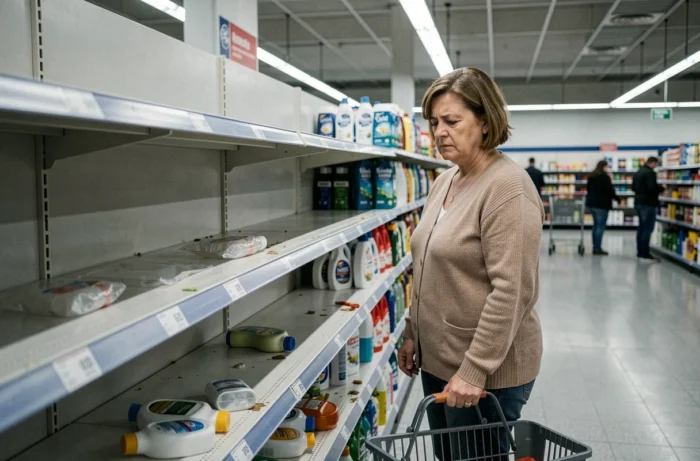
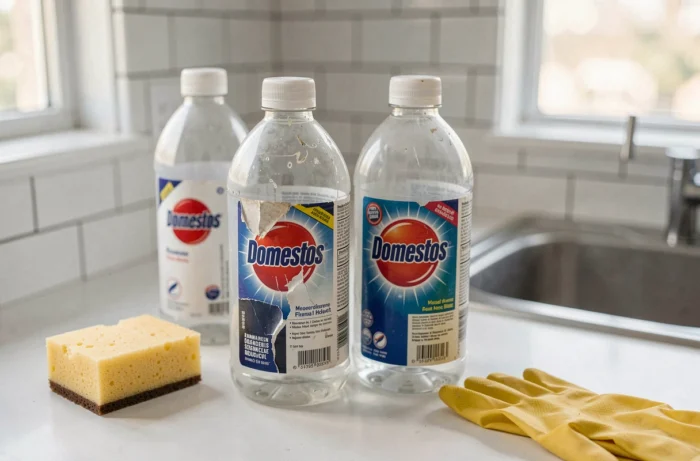
Domestos, the thick bleach brand owned by Unilever, is becoming increasingly rare on the shelves of French supermarkets. This scarcity is not due to a manufacturing or raw materials issue. The mechanisms at play are more related to the commercial strategy between distributors and suppliers, and recent upheavals in the organization of purchasing centers in France.
Buying alliances and delisting: the mechanism that empties the shelves
Since 2024, major French retailers have strengthened their buying alliances, particularly through the AURA and CONCORDIS structures. These groupings allow several distributors to negotiate together with major suppliers of household and cleaning products.
The stated goal is to obtain better pricing conditions. The direct consequence for a supplier who refuses the proposed terms can be a partial or total delisting of their products. The product then disappears from the shelves, not because it is lacking in the factory, but because it is no longer ordered by the retailer.
This phenomenon has already affected several well-known brands. It has been observed with PepsiCo products (Lays, Doritos, Pepsi) temporarily removed from Carrefour, as well as with brands from the Mondelez group (Lu, Milka, Belin). To understand the reasons for the absence of Domestos, one must look at these commercial power dynamics rather than the supply chain.

Competitive assessment by the Competition Authority since January 2026
On January 9, 2026, the Competition Authority launched a first in-depth competitive assessment specifically focused on the AURA and CONCORDIS buying alliances. This initiative aims to measure the real effects of these groupings on competition and on suppliers.
| Element | Before 2024 | Since 2024-2026 |
|---|---|---|
| Supplier negotiations | Store by store | Structured buying alliances (AURA, CONCORDIS) |
| Competitive control | Standard monitoring | In-depth competitive assessment launched on January 9, 2026 |
| Identified risk | Occasional pressures | Coordinated supplier exclusion (coordinated delisting) |
| Supplier recourse | Limited | Challenge of logistical penalties (case law 2026) |
The Competition Authority is particularly assessing the risk of coordinated exclusion of certain suppliers through delisting decisions deemed anti-competitive. A single distributor removing a product exerts standard commercial pressure. Multiple allied distributors simultaneously removing the same product creates a situation that may fall under competition law.
Logistical penalties and supplier recourse
Recent case law shows that suppliers are now contesting logistical penalties imposed by purchasing centers. In 2026, appeals were filed against delisting decisions, notably at Auchan. These procedures illustrate a hardening of commercial relations that goes beyond simple pricing disagreements.
Domestos and the detergent market: a product under competitive pressure
Domestos occupies a unique position in the cleaning aisle. Thick bleach remains a segment where private label brands (PLB) offer alternatives at significantly lower prices. For retailers, favoring PLB over a national brand is a lever for direct margin.
Several factors combine to weaken Domestos’s presence on the shelf:
- Buying alliances enhance the negotiating power of retailers against Unilever, which must accept tighter pricing conditions or risk delisting
- Private label brands meet the same functional need (disinfecting thick bleach) at a lower price, reducing the commercial interest in listing Domestos for the retailer
- The tightening of the regulatory framework on supply exclusivity clauses (case law 2024-2026) limits a supplier’s ability to impose their presence on the shelves
The rarity of Domestos is therefore not a supply chain accident. It is the result of a commercial arbitration where the balance of power leans towards the distributor.
Regulation of distribution contracts: what has changed in 2024-2026
The French legal framework governing relationships between distributors and suppliers has significantly evolved in recent years. Articles L420-1, L442-1, and L462-10 of the Commercial Code are subject to enhanced enforcement, particularly regarding purchasing cooperation agreements.
The exclusivity clauses in distribution contracts are now examined through the lens of competition restrictions and category exemptions. The case law from 2024-2026 has clarified the limits beyond which a group purchasing agreement can be sanctioned.
What this means for the consumer
A product disappearing from the shelf is not necessarily out of stock in the logistical sense. It may be available at the manufacturer, in a warehouse, or even listed at other retailers or online platforms. The local disappearance reflects a commercial disagreement, not a production shortage.
For consumers attached to Domestos, the situation may change with the negotiation cycles. PepsiCo products returned to Carrefour after several months of absence. A delisting is rarely permanent, but its duration remains unpredictable.
The competitive assessment by the Competition Authority, ongoing since January 2026, could alter the practices of buying alliances if abuses are identified. Until then, the availability of Domestos depends less on Unilever’s ability to produce than on the willingness of retailers to maintain it in their listings.