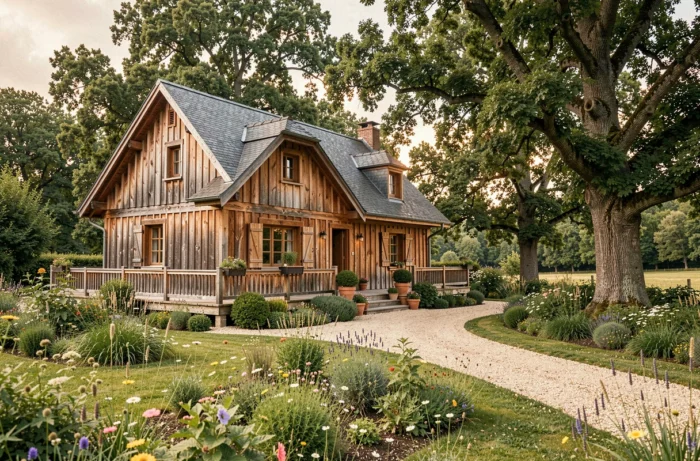
A wooden chalet placed on land that one owns can legally serve as a primary residence in France. The starting condition is simple: the land must be located in a buildable zone according to the Local Urban Planning Plan (PLU), and the corresponding urban planning authorization must be obtained before the start of construction.
Demountable residence and permanent housing: a status distinct from the classic permit
French urban planning law is not limited to the traditional building permit to authorize habitation on a plot of land. Since the ALUR law of 2014, the Urban Planning Code recognizes a specific status: the demountable residence constituting the permanent habitat of its users.
This legal framework, codified notably in article R.111-51, targets lightweight constructions that meet several simultaneous criteria:
- Absence of heavy foundations (blocks, foundation screws, or simple ground support)
- Structure that is easily and quickly dismantled without destruction
- Possibility of autonomy from public networks (water, electricity)
- Effective occupation as a primary residence for at least eight months a year
A wooden chalet mounted on blocks, without a poured concrete slab, potentially falls into this category. The benefit is concrete: the authorization procedure differs from that of a masonry house. For a floor area not exceeding approximately forty square meters, a prior declaration may suffice. Beyond that, a development permit or a building permit becomes necessary depending on the project’s configuration.
The question of living in a wooden chalet on one’s land therefore requires identifying the applicable legal regime for the project in advance, as the obligations change depending on the nature of the structure and its area.
Buildable land and PLU: what the municipality actually imposes
Owning land does not automatically grant the right to build or install a dwelling on it. The PLU of the municipality divides the territory into zones (urban, agricultural, natural, to be urbanized), and only certain zones allow construction for residential use.
In agricultural or natural zones, the installation of a habitable chalet is generally prohibited, except for exceptions. STECALs (Sectors of Limited Size and Capacity) are one of these exceptions. The PLU may delineate, within an agricultural or natural zone, a restricted sector where permanent lightweight housing is allowed under strict conditions.
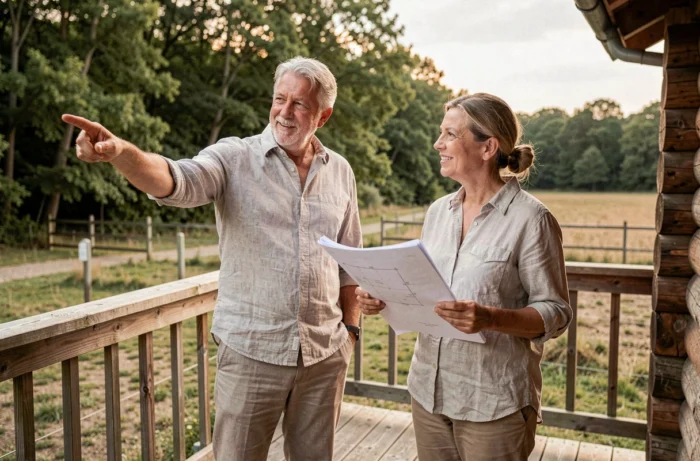
The process begins with a consultation of the PLU at the town hall or on the urban planning geoportal. The document specifies, zone by zone, the applicable rules: maximum height, ground footprint, facade materials, roof slope, setback from property lines. A wooden clad chalet may be refused in a municipality that requires a mineral coating on the facade, even if the land is buildable.
Connection to networks or autonomy
A buildable plot served by public networks (drinking water, collective sanitation, electricity) facilitates the project. In the absence of connection, the municipality may require a compliant individual sanitation system and a solution for drinking water supply.
The status of demountable residence theoretically allows for autonomy from networks, but this autonomy must be real and functional: rainwater recovery with treatment, solar panels, approved ecological sanitation. The town hall checks the viability of these solutions before granting authorization.
Habitable chalet year-round: thermal constraints and RE2020 standard
A chalet intended for permanent habitation is not limited to four wooden walls and a roof. The environmental regulation RE2020, applicable to new constructions for residential use, imposes requirements for energy performance and summer comfort.
Solid wood offers good hygrometric regulation, but its insulating power alone is insufficient to meet regulatory thresholds. Additional insulation (wood wool, hemp fiber, cellulose wadding) is necessary to satisfy RE2020 and ensure real thermal comfort in both winter and summer.
Ventilation and humidity management in a wooden structure
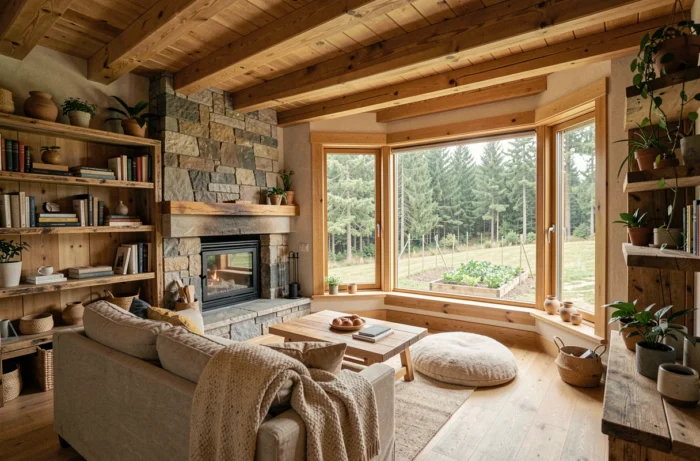
Wood is a hygroscopic material: it absorbs and releases ambient moisture. In a closed and permanently heated chalet, condensation can cause pathologies (mold, rotting of joints) if the ventilation is poorly designed.
A VMC (controlled mechanical ventilation) adapted to the volume of the chalet remains the most reliable system. Double-flow systems, which recover heat from the extracted air, limit energy losses while ensuring air renewal in accordance with health standards.
Taxation of the wooden chalet used as a primary residence
As soon as a chalet serves as a primary residence, it falls under the scope of property tax and housing tax on secondary residences (the housing tax on primary residences has been abolished). The taxable area corresponds to the closed and covered floor area, measured inside the walls.
The owner must declare the construction to the land tax office within ninety days of completion. This obligation also applies to demountable residences occupied permanently. Failing to make this declaration exposes one to a tax reassessment and penalties.
A new chalet used as a primary residence may benefit from a temporary exemption from property tax for two years, provided that energy performance conditions are met and the declaration is submitted on time. This exemption is not automatic: it depends on the deliberations of the municipality and the intermunicipality.
French law thus allows one to reside in a wooden chalet on one’s own land, provided that the zoning of the PLU is respected, the appropriate urban planning authorization for the nature of the construction is obtained, and compliance with current thermal standards is ensured. The status of demountable residence resulting from the ALUR law opens an additional pathway to the classic building permit, particularly suited to lightweight wooden structures mounted on blocks.