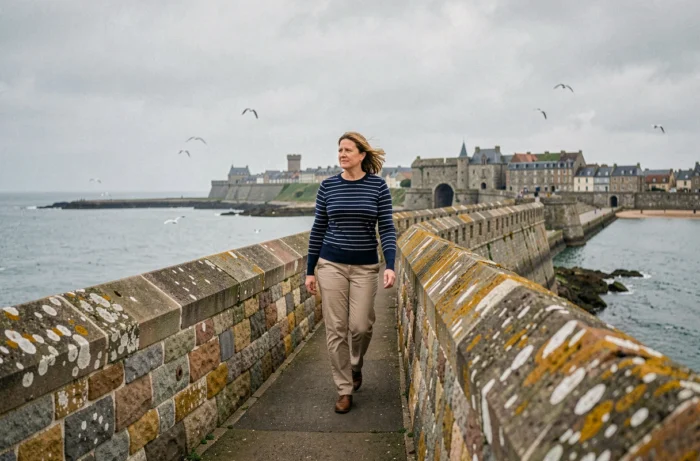
Saint-Malo is a fortified town on the Breton coast whose identity is based on a dual heritage: that of privateering (naval warfare under royal mandate) and that of an urban landscape almost entirely rebuilt after 1944. Understanding this context changes the way one explores the town, as most of the visible buildings within the walls are not medieval but post-war reconstructions faithful to the original style.
Water Quality and Beach Closures: What Changes in Season
Tourist guides list the beaches of Saint-Malo as reliable options. The reality on the ground in 2026 is more nuanced. Several beaches have experienced temporary closures during the peak season, sometimes for just a few days.
Rochebonne beach was closed to swimming in August 2026 after rain showers degraded water quality. It reopened the day after conditions returned to normal, according to the city of Saint-Malo and local press.
Solidor beach, on the other hand, was closed in July 2026 due to pollution from a sewage pipeline. It took five days before it reopened. This type of incident is not trivial: it recurs every time heavy rains occur, a pattern that residents are well aware of.
Before planning a beach day, checking the current municipal orders on the city’s website remains the most reliable precaution. Updated information on beaches and swimming conditions can be found at https://www.saint-malo.net/, which centralizes practical data for preparing a stay.

Saint-Malo Ramparts: Route and Historical Landmarks
The fortified walls surround the Intra-Muros district for over a kilometer and a half. They are divided into two main construction periods: the original walls, from the Middle Ages to the end of the 17th century, and the extensions made between 1708 and 1744.
The ramparts themselves survived the bombings of 1944, unlike the majority of the buildings they protected. This discrepancy explains why walking along the walls gives a sense of authenticity that the reconstructed streets below do not convey in the same way.
Points of Interest Along the Route
- The Quic-en-Groigne tower, near the Saint-Thomas gate, owes its name to an inscription now lost that recalled that Anne of Brittany had it built against the wishes of the Malouins
- The keep of the castle, standing 35 meters tall, marks the entrance to the city and houses the town hall
- The views of the sea, towards the Fort National and the island of Grand Bé, change dramatically between high and low tide
The complete tour of the ramparts takes less than an hour at a leisurely pace. The interest lies as much in the panorama as in the reading of the fortifications: each bastion, each watchtower tells a story of the rivalry between the town and the ducal, then royal, power.
Intra-Muros Accommodation: The Weight of Local Regulations
Finding accommodation in the rampart area has become more complex than it was a few years ago. Saint-Malo applies a more restrictive regulatory framework than many other French cities regarding tourist rentals. The local regulation limits the proportion of tourist rentals within the Intra-Muros perimeter and regulates the number of properties per owner.
This system, which predates the Le Meur law that generalized certain constraints nationwide, effectively reduces the supply of rentals in the hypercenter. For a visitor, this means more limited availability during peak season and rising prices on booking platforms.
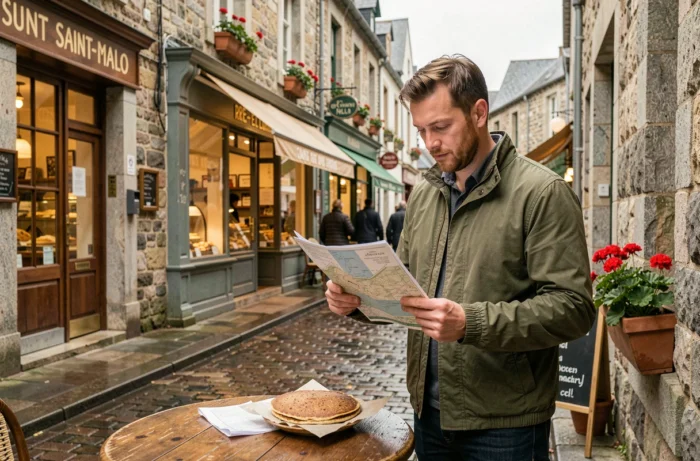
Booking several weeks in advance for a summer stay Intra-Muros is no longer just a recommendation; it is a practical necessity. The peripheral districts (Saint-Servan, Paramé, Rothéneuf) offer often cheaper alternatives, with quick access to the center by bus or bike.
Tides and Live Performances: Two Reasons to Plan Your Stay
The great tides of the Bay of Saint-Malo are among the most powerful in Europe. The highest coefficients transform the landscape in a matter of hours: at high tide, the waves crash against the Sillon dike with spectacular energy, while at low tide, vast stretches of sand and rock appear in front of the town.
Checking the tide calendar before setting your dates allows you to enjoy the phenomenon without unpleasant surprises. On days with high coefficients, some pedestrian areas near the coast may be submerged by spray.
Recent Events and Immersive Experiences
The cultural offering is expanding beyond built heritage. Terra Aletia, an immersive sound and light show highlighted since 2026, offers a scenographic interpretation of local maritime history. This type of production complements more established events like La Route du Rhum (transatlantic race starting from Saint-Malo) or the Étonnants Voyageurs festival.
The event program varies greatly depending on the months. A stay outside of July-August can yield pleasant surprises, with more manageable attendance and significantly lower accommodation rates.
Saint-Malo is experienced differently depending on whether you arrive with a tide coefficient of 40 or 110, whether it rained the day before or not, and whether you booked Intra-Muros or in Paramé. The city rewards those who prepare their visit with a minimum of concrete data rather than those who rely on postcard clichés.