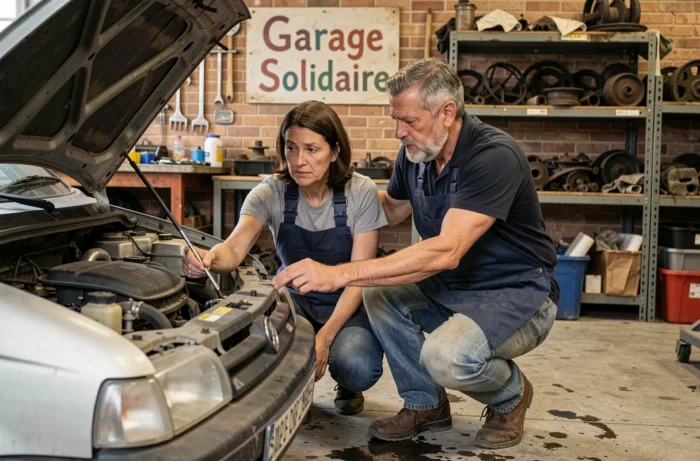
A timing belt to replace, a worn clutch, worn brake pads: when the mechanic’s bill exceeds the available budget, the car stays in the garage, along with the possibility of working. Solidarity garages offer a concrete alternative to keep a vehicle in good condition without falling into financial deadlock.
Fragility of the economic model of solidarity garages in France
Solidarity garages are often talked about as a reliable safety net. The reality on the ground is more nuanced. In September 2026, the association Solidarauto, which operated the only solidarity garage in the Rouen metropolitan area, was placed in judicial liquidation, leading to the closure of the site and the layoff of nine employees.
This case illustrates a structural financial vulnerability: these structures depend on a mix of local subsidies, vehicle donations, and a precarious customer base that does not generate profit. When a funder withdraws or donations decrease, the garage closes. Before relying on a solidarity garage near you, check that it is still operational. The network listed on garages-solidaires.fr allows you to locate operational structures in the area.
This precariousness of the model drives some garages to diversify their resources: resale of refurbished used vehicles, partnerships with local authorities or temporary employment agencies like Fastt, which directs its temporary workers towards discounted repairs.
Access conditions and eligibility criteria for solidarity garages
You don’t just walk into a solidarity garage like you would a regular auto center. Access is conditioned on a situation of precariousness, most often verified by a social worker or a referrer (local mission, Pôle emploi, CCAS, integration association).
The profiles concerned are varied: job seekers, RSA beneficiaries, precarious workers, temporary workers, young people in integration. The common point is a need for mobility to access or maintain employment, and insufficient resources to pay for a traditional garage.
Obtaining concrete guidance
The process almost always goes through an intermediary. Here are the usual steps:
- Contact a social referent (Pôle emploi advisor, CCAS social worker, local mission advisor) who assesses the mobility situation
- Obtain a prescription or order form directing to the solidarity garage partner in the area
- Make an appointment directly with the garage, which establishes a quote adapted to solidarity rates
Without this guidance, most structures will refuse to take on the case. Feedback on this point varies by region, with some garages accepting direct requests under certain resource conditions.
Automotive repair at reduced prices: what is actually covered
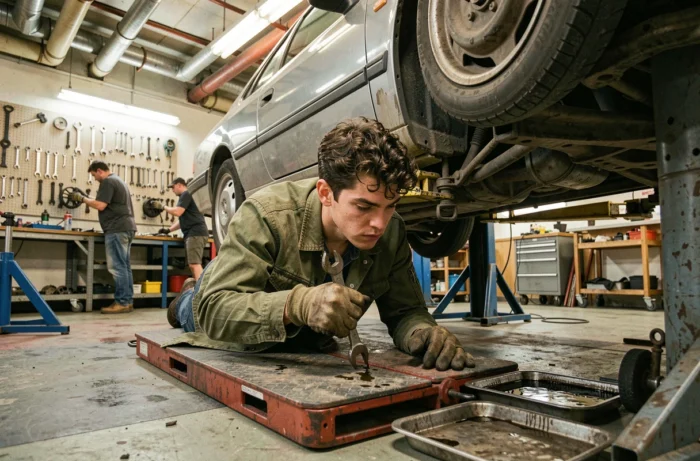
A solidarity garage does not do everything. The services cover routine maintenance and repairs necessary for safety: oil changes, brake pad replacements, shock absorbers, belts, exhausts, tires. Some also offer technical inspections or preparation for inspections.
The reduced rate is explained by two levers. The cost of labor is significantly reduced, as garages operate with employees in integration, volunteers, or supervising mechanics whose positions are funded by public aid. Spare parts often come from the used parts sector or reuse, which lowers the total bill.
Self-garage and associative garage: two different logics
Solidarity garages and self-garages are often confused. A self-garage rents out a lift and tools to individuals who repair their own vehicles. It is open to everyone, without resource conditions. The rate is low, but you need to know how to do it.
The solidarity garage, on the other hand, provides qualified labor at an adapted rate. Some structures combine both formulas: a self-service area for simple repairs and mechanical support for heavier interventions.
Vehicle donations and solidarity mobility: an ecosystem under construction
Repair is just one aspect of the problem. For people who do not have a vehicle at all, the platform DonnezVotreVoiture.org, supported by Roole and Solidarauto, collects car donations from individuals. Three years after its launch, this initiative is approaching 4,000 vehicle donation offers.
The principle is simple: an individual donates a vehicle they no longer use for free. The solidarity garage refurbishes it if necessary, then sells it at a very low price or directly assigns it to a person referred by a social referrer. This circuit allows for recycling cars that would have ended up in the junkyard while addressing a concrete mobility need.
However, this chain remains fragile. Refurbishing a donated vehicle has a cost, and if the solidarity garage responsible for it closes (as in Rouen), the collected vehicles remain in limbo. The territorial network remains uneven: some metropolitan areas have several structures, while others have none.
Car maintenance and tight budget: complementary alternatives
When there is no accessible solidarity garage, other options exist to reduce the car repair bill:
- Auto centers (like Norauto, Carter-Cash) charge lower labor rates than independent garages, with regular promotions on routine maintenance
- Reused parts from authorized VHU centers cost a fraction of the price of new for items like headlights, mirrors, or body parts
- Fastt offers temporary workers access to a partner repair network with negotiated rates
- Some local authorities fund occasional repair assistance through youth aid funds or departmental mobility assistance
A solidarity garage remains the most comprehensive solution for eligible individuals because it combines low rates, social support, and accessible parts. For everyone else, combining used parts and competitively priced auto centers can already help reduce the bill.