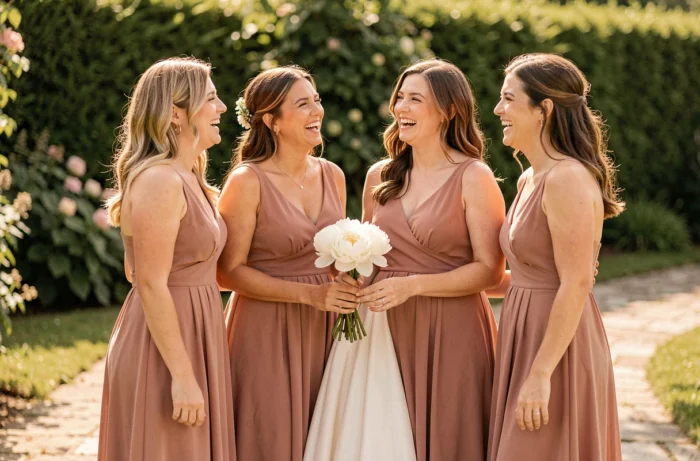
The term “bridesmaid” implies that one should be single to occupy this role during a wedding. This idea, inherited from an ancient Anglo-Saxon tradition, continues to sow doubt among future brides and their loved ones. The question deserves to be asked clearly: can a married woman be part of the bridesmaid procession?
Bridesmaid and marital status: what Anglo-Saxon tradition says
In American and British tradition, a linguistic distinction separates two roles. The “maid of honor” refers to a single woman, while the “matron of honor” applies to a married woman holding the same position. This terminological nuance has long served as an unspoken rule in English-speaking weddings.
In France, this distinction has never had any legal or religious basis. The Civil Code regulates the role of wedding witnesses (a minimum of two, a maximum of four), but no text mentions bridesmaids. Their presence is a social custom imported, not a legal obligation.
The possibility of being a bridesmaid while married therefore poses no regulatory issue, as this role does not adhere to any formal rules in French law.
Modern wedding etiquette: emotional connection takes precedence over status
Recent etiquette guides converge on one point: the determining criterion is the emotional bond with the bride, not marital status. The logic of inclusion has replaced the traditional filter. Married friends, singles, couples, mothers, all can be part of the procession as long as the bride wishes to have them by her side.
This evolution reflects a simple demographic reality. The average age at first marriage has decreased in France in recent decades. Brides often choose their bridesmaids from close friends in their age group, a significant portion of whom are already married or in stable relationships.
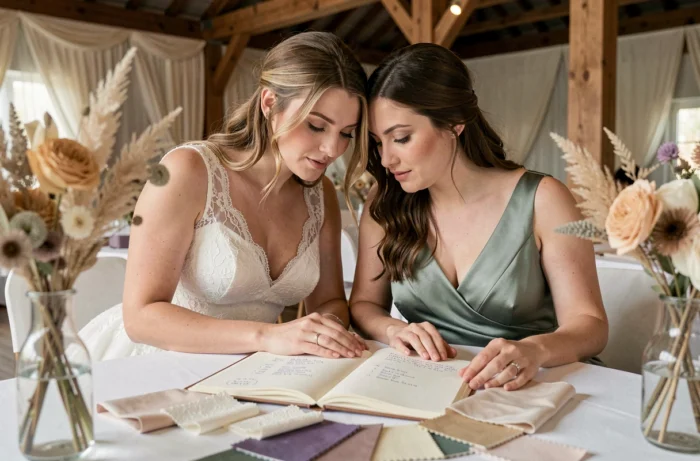
Refusing a married friend for this role would mean depriving oneself of the closest and most invested person, in the name of a convention that no one strictly applies anymore. The bridal party is composed based on affection, not civil status.
Common confusions between wedding witness and bridesmaid
The confusion between these two roles fuels part of the misunderstanding. Wedding witnesses have a legal role: they sign the marriage certificate at the town hall and attest to the reality of the union. Their number and conditions are regulated by law.
Bridesmaids, on the other hand, fulfill an exclusively social and organizational role. Their tasks vary from one wedding to another:
- Accompanying the bride in preparations (choosing the dress, organizing the bachelorette party, logistics for the big day)
- Forming the procession during the ceremony, whether civil, religious, or secular
- Ensuring a coordination role on the wedding day (welcoming guests, managing unforeseen events, providing emotional support)
A married woman can be both a witness and a bridesmaid at the same time, or occupy only one of these roles. The two functions are independent of each other.
The real barrier: the cost of the role, not the ring on the finger
What truly deters some women from accepting the role has nothing to do with their marital status. According to a British survey, nearly 60% of former bridesmaids feel that the role cost them more than expected. One third of participants spent between £250 and £499 at the last wedding they officiated.
The matching dress, accessories, participation in the bachelorette party, travel, gifts: the bill adds up. For a married woman, with her own family and financial responsibilities, this practical aspect weighs more heavily than the question of etiquette.
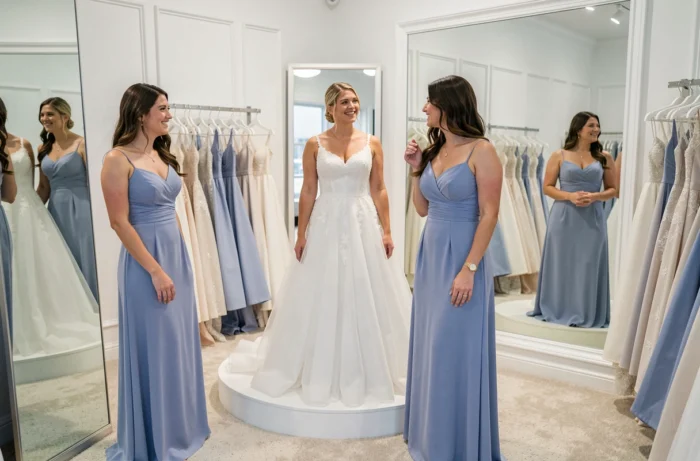
The proportion of women who have been bridesmaids at least once exceeds a quarter of the adult female population in the UK, and this figure rises to more than a third among those aged 25-34, an age group where many are already married. The role has become common, not reserved for singles.
Managing remarks and adapting vocabulary
In some family circles, the word “bridesmaid” can provoke remarks. A simple solution is to use the term “honor attendant” to designate a married woman in the procession. This term exists in French and removes any ambiguity without renouncing the function.
The bride can also choose not to burden herself with terminology and present her procession as her “women of honor” or simply her loved ones. Usage evolves and vocabulary follows.
- Honor attendant: an appropriate term for a married woman, the French equivalent of “matron of honor”
- Woman of honor: a neutral formulation that avoids the question of status
- Bridesmaid: remains usable regardless of marital status, by modern convention
The choice of words belongs to the bride. No authority, civil or religious officiant will verify the civil status of the honor procession.
The only question that matters when forming her procession is one of trust and closeness. A married friend who knows the ins and outs of a ceremony from having experienced it herself brings concrete experience on the big day, which is no small asset.