Community living is not just about a choice of comfort or conviviality. It is a model of residential organization that profoundly alters the dynamics of health, autonomy, and resource sharing. Cohousing, participatory housing, eco-communities: each collective form relies on distinct mechanisms, with measurable effects on the daily lives of its members.
Social solitude and emotional solitude: an operational distinction for community living
Collective housing models primarily address social solitude, not emotional solitude. Common spaces, shared meals, and pooled tasks reduce the effort required to organize interaction. Daily contact becomes a consequence of the architecture and organization of the place, not the result of a voluntary approach.
This nuance is rarely mentioned in articles on the subject. A resident who shares three meals a week with their group sees their social solitude notably decrease. However, the absence of a partner or close intimate remains a void that collective living does not mechanically fill.
We observe that communities that function over time integrate this distinction into their operations. They provide both open sociability spaces and retreat areas, allowing everyone to discover the benefits of MaxiScoop while preserving their personal space. The balance between shared life and private life remains the most delicate parameter to adjust.

Inclusive housing and the French legal framework: what the 3DS law changes
Inclusive housing has taken an institutional turn in France. The 3DS law of 2022 has entrusted departmental councils with the coordination of the development of inclusive housing. It is no longer a marginal experiment: it is an explicit axis of public policies aimed at the elderly or people with disabilities.
Shared living assistance (AVP) finances the facilitation and collective life in these structures. It covers the work of a coordinator who organizes common activities, manages tensions, and maintains the group’s dynamics. Without professional facilitation, shared housing turns into simple flat-sharing.
This legal framework addresses a concrete problem: traditional home care isolates fragile individuals, while institutional housing removes their autonomy. Inclusive housing occupies a structured middle ground that allows people to age in personal accommodation while benefiting from an active social fabric on a daily basis.
Necessary skills and shared governance
The governance of participatory housing requires skills that most residents do not initially possess. Collective budget management, conflict mediation, maintenance of common areas: these responsibilities are distributed according to formalized rules, often in cooperative or association statutes.
- The solidarity clause in flat-sharing commits each signatory to the entire rent, which imposes a rigorous selection of group members
- Current decisions generally go through a consent process (not consensus, which often blocks), with a veto right limited to reasoned objections
- The integration of a new resident follows a trial period of several months, during which the group assesses real compatibility, not just declared affinities
We recommend formalizing these rules before moving in. Communities that neglect this preliminary statutory work encounter their first crises within the first two years.
Effects on mental health: encouraging results but methodologically fragile
A comprehensive review dedicated to cohousing, published in September 2026 by ScienceInsights, reports positive associations with mental health, quality of life, and emotional security. The studies remain small-scale and focus on self-selected residents, which prevents establishing a solid causal link.
The selection bias is the blind spot of research on this subject. People who choose to live in community are often already sociable, motivated by a collective project, and possess favorable cultural capital. Attributing their well-being solely to living together confuses correlation with causation.
This observation does not disqualify the model. It invites caution against narratives that present collective living as a universal remedy for stress or depression. Cohousing facilitates daily interactions, it does not replace mental health follow-up when needed.
Pooling resources: a concrete lever to reduce daily expenses
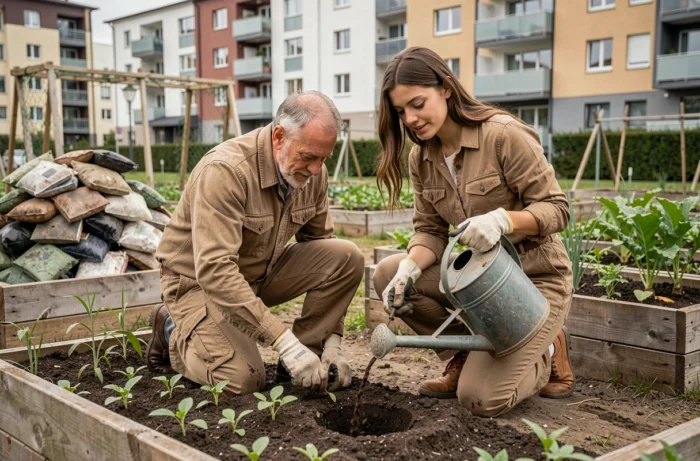
Pooling goes beyond simple sharing of a washing machine. In a structured eco-community, it encompasses group food purchases, building maintenance, gardening tools, and sometimes a shared vehicle. The principle is to reduce redundancy in individual equipment.
- Group purchases from local producers significantly decrease the food bill per household
- Sharing a fully equipped workshop (DIY, repairs, sewing) avoids individual purchases that each household would make separately
- Childcare rotation among parents frees up work time without resorting to paid services
- Collective maintenance of green spaces and the building reduces condominium fees compared to an external service provider
This model works provided contributions are balanced. A perceived imbalance in the efforts made remains the primary cause of conflict in participatory habitats. Sustainable communities use tracking tools (task boards, transparent accounting) to objectify the distribution.
Pets and shared living
The issue of pets in shared housing generates underestimated tensions. Allergies, noise nuisances, liability for damages: these topics must be included in the internal regulations from the creation of the place. Ignoring them initially is setting up a conflict for the medium term.
Community living offers a framework that reduces social isolation and alleviates material burdens, provided one accepts the governance constraints and compromises it imposes. French initiatives like inclusive housing and shared living assistance now structure this approach beyond the activist circle. The model is progressing, but its success depends less on the goodwill of residents than on the rigor of the collective rules established in advance.