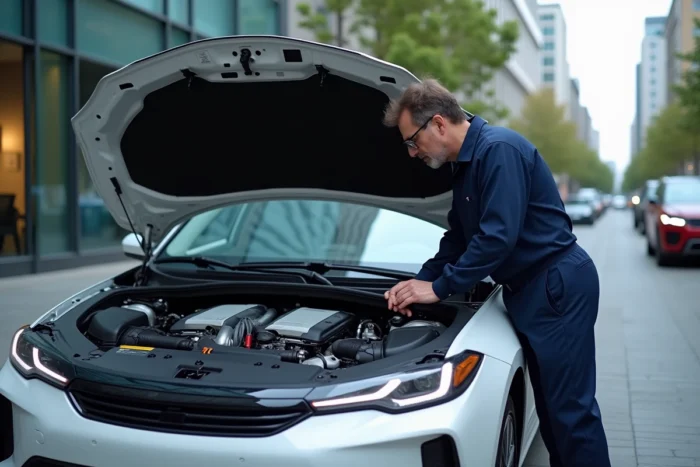
The French automotive market now includes several dozen hybrid models, from micro-hybrids to plug-in hybrids. Behind this commonly used term lies a more nuanced mechanism than simply adding a battery to a thermal engine. The tax rules surrounding these vehicles have also changed significantly since 2023, reshaping their real appeal to buyers.
What the term hybrid covers technically
A hybrid car combines two distinct energy sources to propel the wheels: a thermal engine (gasoline or diesel) and an electric motor powered by a battery. The way these two units cooperate varies depending on the architectures, and this is where confusion arises.
In a so-called parallel system, both engines can drive the wheels simultaneously or separately. The electric motor assists the thermal engine during acceleration, then takes over alone at low speeds. In a series system, the thermal engine never touches the wheels: it only serves as a generator to recharge the battery that powers the electric motor.
Most mainstream manufacturers (Toyota, Honda, Renault) use variants of these two logics, sometimes combined in a series-parallel system. To delve deeper into the definition of a hybrid car and its variants, it is essential to distinguish three categories that have very different impacts in use.
Micro-hybrid, full hybrid, plug-in: three different realities

The term hybrid is used for vehicles whose degree of electrification is not comparable. Grouping a mild hybrid and a PHEV under the same label is akin to putting an electric bicycle and a scooter in the same basket.
- Mild hybrid (MHEV): a starter-generator recovers energy during braking and provides a slight boost at startup. The vehicle never runs in purely electric mode. The fuel consumption savings remain modest.
- Full hybrid (HEV): the electric motor can propel the vehicle alone over short distances and at low speeds. The battery is recharged exclusively through kinetic energy recovery and via the thermal engine. No plug is necessary.
- Plug-in hybrid (PHEV): a larger capacity battery allows for several dozen kilometers in 100% electric mode. It can be recharged at a household outlet or a charging station. This is the only type of hybrid that offers significant electric range for daily use.
This distinction is far from trivial. The type of hybridization determines actual consumption, maintenance costs, and the tax treatment of the vehicle.
Energy recovery and electronic management: the true engine of efficiency
Regenerative braking is the central mechanism of any hybrid powertrain. When the driver lifts their foot or brakes, the electric motor operates as a generator: it converts kinetic energy into electricity stored in the battery. Without this system, the battery of a full hybrid would not recharge.
The management electronics play a crucial role. A computer constantly decides which motor to engage, when to cut off the thermal engine, and when to switch to electric. On an urban route with frequent stops, a full hybrid can run in electric mode up to half the time, significantly reducing consumption compared to a pure thermal vehicle.
On the highway, however, the thermal engine takes over almost entirely. The battery of an HEV is too small to maintain high speeds in electric mode, and energy recovery during braking is nearly nonexistent on a continuous flow. Field reports vary on this point: some drivers notice a consumption gain even on the road, while others do not, depending on the route profile and driving style.

Taxation of hybrids in France: a tightened framework since 2023
Articles presenting hybrid vehicles often mention tax advantages that no longer exist. The French regulatory framework has undergone several close changes that concretely alter the economic calculation.
The ecological bonus has no longer been accessible to plug-in hybrids since January 1, 2023. Only 100% electric vehicles can still benefit from it. The conversion bonus, which could apply to certain hybrids, has been eliminated for all vehicle categories starting December 2, 2024.
Since 2025, PHEVs no longer benefit from exemptions from the new components of the company vehicle tax related to CO₂ and pollutant emissions, even for very low-emission models. The regional tax reduction on registration cards for hybrids emitting less than 20 g/km has also ended since 2025.
For corporate fleets, this tightening of tax rules weighs heavily. A PHEV that enjoyed favorable tax treatment two years ago is now taxed similarly to a conventional thermal vehicle.
European customs duties: an additional pressure on PHEVs
The European Union is preparing to extend the countervailing duties already applied to Chinese electric cars to plug-in hybrids imported from China. The announced surcharges range from approximately 17% to 38% depending on the brands concerned.
This measure aims to rebalance competition against Chinese public subsidies. For the European consumer, it could significantly increase the price of certain entry-level PHEVs that have gained visibility in recent years. Available data does not yet allow for measuring the exact impact on sales volumes, but the trend is clear: the regulatory context is tightening for plug-in hybrids, both in terms of domestic taxation and at the European commercial level.
Choosing a hybrid powertrain remains relevant in certain use cases, particularly for urban and suburban trips where regenerative braking and electric phases effectively reduce consumption. The full hybrid retains a simplicity advantage, with no charging to manage.
The plug-in hybrid remains appealing for drivers who can plug in daily and whose home-to-work trips stay within electric range. For all other profiles, the economic benefits have diminished, and a numerical comparison between thermal, hybrid, and electric, tailored to annual mileage, becomes the only reliable decision-making tool.